
What Is a Client Success Manager (And Do You Need One)?

Customer support is more important than ever, yet it’s also more complicated. Buyers will reach out through a wide variety of channels, and expect fast, personalized service. If they don’t get it, they’re likely to complain in visible ways that can hurt your brand.
For these reasons, the ‘client success manager’ is becoming an increasingly popular role. What do they do, and how are they different from traditional customer support agents? And most importantly, do you need one?
Let’s answer those questions!
What Is a Client Success Manager?
A Client Success Manager or CSM (also sometimes called a ‘customer success manager’) maintains and enhances client relationships. They aim to ensure that your customers get the maximum value from your products or services.
In this role, empathy and interpersonal skills are vital. A CSM has to understand client needs, and tailor experiences to meet those needs.
At the same time, the role requires a keen understanding of metrics. By leveraging data analysis, a CMS can track client engagement, identify patterns, and make targeted improvements.
Unlike customer support, which is typically reactive, the CMS role is proactive. The goal is to anticipate needs before they become issues. While support resolves immediate problems, a CSM strategizes for long-term satisfaction and growth.
In terms of education, a background in business or a related field is often required. However, workplace skills such as troubleshooting and on-the-job experiences are equally essential.
What Does a Client Success Manager Do?
The exact job description will vary based on the needs of the individual business. But on a typical day, a CMS will likely:
- Monitor accounts
- Communicate with clients
- Analyze usage data
- Collaborate with your team to improve client success strategies
The goal? To ensure that each client is fully satisfied, and that their experience with your company improves their lives or work.
The Pros and Cons Hiring a Client Success Manager
If your business wants to enhance customer retention and foster robust relationships, a client success manager can help. However, no role is necessary in every business.
To decide whether this is a type of person you need on your team, it’s important to understand the pros and cons.
The advantages of hiring a client success manager include:
- Increased customer retention. A dedicated client success manager focuses on keeping customers satisfied and engaged. When done well, this can lead to higher retention rates.
- Better product value. They can work closely with development teams to ensure that your product or service’s value is fully realized by customers. In turn, this can positively influence product usage and satisfaction.
- Enhanced teamwork. These managers bridge gaps between your sales or customer support team and your product teams, fostering better communication.
- Customer advocacy. CMSs often become customer advocates, providing feedback that drives improvement and innovation.
On the other hand, you’ll want to consider:
- The cost. Hiring a new employee is always a notable expense, and a CMS is an expert who commands a high rate. Glassdoor estimates the median CMS salary at around $150k per year in the US. Because of the knowledge and skills required, training an existing team member to fill this role and providing them with the resources they’ll need may be nearly as costly.
- Your business’ size. A client success manager works best alongside an existing customer support team that’s robust. Plus, many of their benefits lie in improving communication between diverse areas of the business and making sense of large amounts of data. If your company is small and/or you have a minimal support team, this kind of role might be unnecessary.
- Your willingness to adapt and make changes. A quality customer success manager will likely identify big changes that should be made. They may even recommend an entirely new approach to customer support or communication. To make the most of them, you’ll have to be willing to get the whole team onboard and implement those changes.
Do You Need a Client Success Manager?
So how do you weigh up the advantages and drawbacks? As you decide whether you need a client success manager in your business, the following considerations will be key:
- Business size and complexity. For large or rapidly growing companies, a CSM can be crucial in managing increasing customer expectations and complex needs. As mentioned earlier, they can be overkill for small businesses.
- Customer onboarding needs. If your products or services have a high learning curve, a CSM can ensure that the right knowledge is being communicated. If they’re quick and simple to use, this aspect becomes less crucial.
- Customer type and industry. B2B businesses with long-term clients may benefit more from a CSM than B2C companies focused on one-time sales.
- Importance of continuous education and product upgrades. A CSM is beneficial if your product teams frequently release updates, requiring ongoing client education. If you rarely need to communicate with customers after a sale is made, more traditional support may be enough.
In addition, make sure to consider whether it’s really a CMS that you need. A client support manager acts as a bridge between the business front end and back end.
What it’s not is a product development or sales role. So if you feel that your business might be lacking in those areas, it’s better to shore up those roles first. Otherwise, you may not have the resources in place to implement a CMS’s strategies.
How To Choose the Right Client Success Manager
If you’ve decided to start looking for a client success manager, it’s important to take your time. This is a crucial individual who will be making high-level decisions for your company, so you’ll need to assess both their personal qualities and professional skills.
Some key abilities to look for include:
- Strong communication skills: Your CSM should be an exceptional communicator, adept in both verbal and written forms.
- Strategic thinking: Look for someone who shows a strong strategic mindset, in order to understand client needs and business objectives.
- Customer service mastery: Excellent customer service capabilities are critical, so the CSM can manage relationships effectively.
A few other qualifications to consider:
- Experience: Prioritize candidates with a proven track record in client-facing roles. Prior success in a similar role is key, ideally evidenced by client testimonials.
- Educational background: A degree in business management or related fields will be beneficial. So will industry-specific knowledge that aligns with your company’s market.
You can use a structured interview process to evaluate these competencies, combining behavioral questions with scenario-based tasks to gauge how candidates perform in real-life situations.
Finally, if you have a strong customer service team with one or more competent leads, you might consider promoting internally instead. However, this will likely take more time and training.
So to start off on the right foot, be sure to select someone with a keen understanding of your company’s products and services, as well as the ability to nurture and grow client relationships.
Measuring Client Success Manager Performance
Like any other employee, it’s important to keep tabs on your client success manager’s performance. To do that, you can focus on various metrics and key performance indicators (KPIs) that reflect customer success and service health, such as:
- Customer Satisfaction (CSAT) and Net Promoter Scores (NPS), which directly gauge customer loyalty and the likelihood of referrals
- Renewal Rate / Churn, to understand customer retention
- Upselling and Cross-Selling Rates, as they reflect your CSM’s ability to deepen customer relationships by addressing additional needs with your products or services
- Product usage data, which shows whether customers are fully utilizing your services (indicating the CSM’s success in driving engagement)
- Revenue – your bottom line is influenced by customer service health, so trends in this area can signal your CSM’s impact
- Customer service KPIs such as response times, resolution times, and ticket volumes
Those last few indicators can be monitored using Groove. Our customer support dashboard gives you an easy way to see important analytics.
This means you get real-time insights into how effectively your CSM addresses support issues:
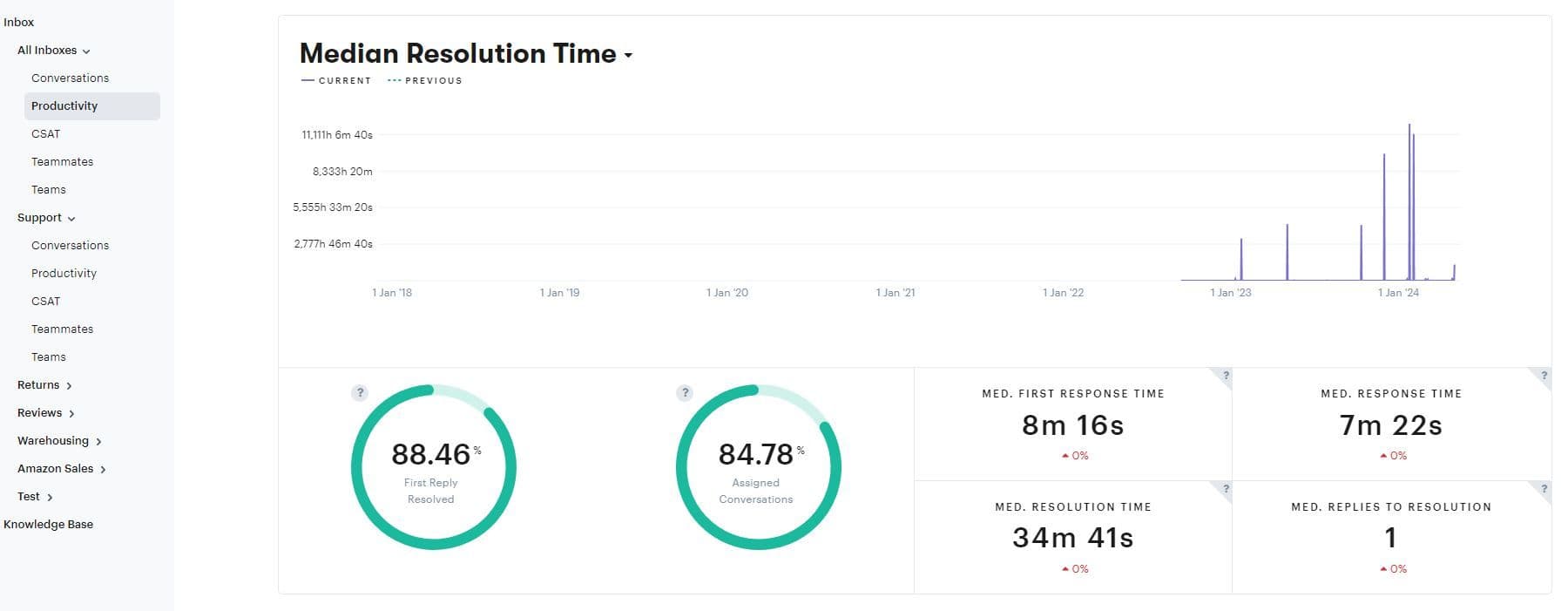
Equipping your CSM with a tool like Groove can also enhance their performance, by providing the necessary analytics to drive customer success. Data analysis becomes streamlined, allowing for immediate action and strategy adjustment.
Plus, if you don’t feel a CSM is right for your business, Groove can fill some of the same roles. It provides a centralized place for all customer communications, allowing you to monitor your support team and identify areas for improvement without the need for a costly expert.
Ensuring Effective Customer Support at Any Business Size
Each business is unique, so there’s no one-size-fits-all answer for how to best manage customer service. If your company is already sizable and stable, with a robust support team, it might be a good time to consider hiring a client success manager.
On the other hand, many businesses often can’t afford or support such a specialized role. Fortunately, you don’t need a CMS to provide top-quality customer service.
Groove provides small businesses with the tools and data needed to keep customers happy and drive improvements. Check it out today!
5 Help Scout Alternatives: Why Growing Support Teams Switch to Groove
Groove Fixes What Teams Don't Like About Help Scout: Flat Pricing, Built-In AI, and Native SLA Management. See the Full Comparison.
How Helply's Hallucination-Proof AI Eliminates the #1 Fear of AI Customer Support
Customer Support Automation That Hits 65% AI Resolution, Guaranteed. Helply's Action-Based AI, Safe Escalations, and Optimization.