
Customer Service Resume Writing: Tips & Examples
Wanted: Customer Service Specialist. Years of Experience required: 2-5. Pays $75,000. Go.
Sound familiar? If you’ve ever dreaded writing prompts in school, writing a resume can feel like the world’s most high-pressure writing prompt. With just a few sentences, hiring managers expect you to craft a resume that accomplishes the following:
- Does a thorough job of highlighting your exact experience (but isn’t wordy)
- Is free of grammatical mistakes and punctuation errors (but has its own unique punctuation quirks)
- Looks crisp on the page, as though you’re a professional designer (even though you’re not a designer and maybe haven’t even met one)
How are you supposed to get it right? And getting it right is particularly important in customer service, where you need a resume to highlight your people skills. How do you demonstrate something as abstract as “people skills” in plain font on an 11 x 8 piece of paper?
It’s all too much. That’s why you need a guide.
We’ve put together a list of tips to help you along the way. Even if you’re not working in customer service, there will be clear takeaways from this post that you can apply to your job search immediately. But if you are in customer service, you’ll find some industry-specific knowledge that will help you gain the attention of hiring managers who are looking for a resume with that WOW!factor.
Tips that Make Any Resume Work Better, Regardless of Industry
It’s important to focus on the specific tips that will make your resume look better. But before we dive into the nitty-gritty details, let’s zoom out. What can you do to make sure that any resume you write will be more engaging for hiring managers?
- Approach resume writing like a journalist. Journalists use the upside-down pyramid approach: give away the most pertinent information up top. A resume is not storytelling time, where you want to hide something from the reader. You’re writing your resume for hiring managers who are scanning a hundred resumes just like yours. Put your most important information in bullet points. Make sure the best points are at the top of each section.
- If you have more experience, avoid the single-page resume. Some people like the tidiness of a short resume. But if you have a lot of experience to highlight, aiming for a single page can short-change your real value. 77% of employers surveyed said people with more experience should feel fine going over one page.
- Write more than one resume. 63% of recruiters would prefer a resume tailored to the exact position. If you know exactly what kind of job you want and your experience matches it perfectly, go for it. Write one resume. But you can optimize your chances of success if you write multiple resumes with specific goals in mind. For one resume, you might focus on customer service management, for example. In another, you might highlight a different aspect of your experience. Don’t be afraid to tweak and even write new resumes as you explore what hiring managers are really looking for.
- Play the law of averages. Some estimates put the hiring rates at about 2 to 3%. That means that if you send out 50 resumes, you can expect about one job offer. And even that statistic is assuming all sorts of things that may not apply to your situation. So once you’re confident in your resume, remember that you still shouldn’t expect to send it out just once. Keep working this system until you get noticed.
Tips for Writing a Great Customer Service Resume
There’s something unique about customer service that you’ll want to highlight: you’re a people person. You’re pleasant to talk to.
But there’s also a problem. Resumes, by their very nature, tend to be dry and boring. How can you liven things up and use a traditionally PDF-or-paper medium to make your customer service skills come alive? Here are some ideas.
- Be as tangible as possible. Let’s say you ran the customer support line at a company and immediately reduced customer complaints by 30%. How much more engaging is it to simply write that out? That is a real-world result of your work. And to someone who doesn’t know you, it will sound far more compelling than using vague terms like “led a team” or “managed live chat.” If you have tangible results, treat them like the gold nuggets they are.
- Include references. Since customer service is a peoples’ industry, it doesn’t hurt to call out a few contacts you’ve made along the way. If you work in customer service, it will be expected of you. And if you’re okay with using up some extra space, you might even include a testimonial or two.
- Ask questions from your previous employers. Can they offer you statistics? Ironclad reviews of your performance, such as feedback ratings? Anything with a good number looks good on a resume; otherwise, you’ll find yourself having to explain your experience during the job interview itself. When that happens, it will feel like playing catch-up, and for good reason: you are. The more direct experience you can put in the resume, the better.
Hiring managers care about one thing: work experience. Can you demonstrate that you have the work experience necessary to do the job, or are you forcing them to hire you on potential? The job of your resume is to make it feel like they’re not taking a chance. They’re hiring a sure thing.
Skills Section: What Skills Should Customer Service Resumes Highlight?
The best answer? That depends.
If you’re looking for a leadership role and have a lot of experience under your belt, you should certainly highlight that experience off the bat. Don’t just talk about your customer service experience. Talk about the experience you’ve had in leadership roles. Did you lead a team? If so, how many people did you lead? Did you lead that team to any particular results?
Hiring managers looking to hire leaders are more forgiving of resumes that run 2-3 pages. After all, by that point, you’re supposed to have gathered enough experience to justify the use of space.
If you’re looking for a mid-level role in customer service, then highlight the skills that will be relevant for that: people skills, the ability to work well in a team, as well as the ambition to potentially be in a leadership role some day. However, at this stage, it’s less important to display direct leadership experience as you highlight different sections of your resume.
If you’re looking for an entry-level position, you might include some experience that isn’t directly related to customer service. That’s fine. But make sure that you do highlight the key skills you acquired in your previous positions that may translate to customer service in the future.
When going for a customer service job, consider if these skills are relevant to list on your resume for previous roles you’ve had or future roles you want:
- Technical skills, interpersonal skills, soft skills, analytical skills, managerial skills, data entry skills, leadership skills, customer service skills, empathy skills/training, written/verbal communication skills, bi/multilingual, project management skills, creative skills
Writing the Resume Objective
This is one of the most vexing sections on the entire resume. It’s like a 2-3 sentence writing test, and nothing ever seems to fit just right. Here are the answers to two key questions people ask about the objective:
Should You Even Write a “Resume Objective”?
If it’s giving you too much trouble, no. CareerSidekick.com, for example, considers them outdated. Recall that today’s hiring managers have access to tools like ZipRecruiter, which lets them access hundreds of resumes a day. Unless you’re writing an Objective worthy of Shakespeare, chances are that it’s not going to swing things either way.
How Should You Write a “Resume Objective”?
We’ll start with a challenge: don’t use the word “I” or “Me.” Think exclusively about what you can offer someone who would hire you for the position.
Let’s take a look at two examples below. Which person would you hire?
Example #1:
I am a fast learner, a strong team member, and looking for a job that excites me in the field of customer service. I am looking to work with a company that does at least $10 million in revenue.
Example #2:
Customer service manager looking to bring over 10 years of customer service satisfaction growth to enhance customer loyalty for $10m+ revenue businesses.
Example #2 describes the same thing: someone seeking a job at a specific type of company. But while Example #1 is all “I” and “Me,” Example #2 focuses on the benefits of hiring you. It talks about your plans. And it does it all in one sentence. What’s more exciting to a hiring manager: what you can do for the business, or what the business can do for you?
Who would you rather hire?
How to Write the “Experience” Section While Highlighting Your Background
Build your experience by sections, with bullets to highlight individual experiences. Every section should be a position of previous employment. For example, if you worked at ABC company for two years and then XYZ company for three, start with the most recent: XYZ. Think of it as telling the story of your rise in skills and experience.
Then, underneath each section, list the bullet points. Start with the basics at the top (Name of Company, Your Position There, Dates Employed), and then underneath, list some basic bullets that highlight the specific experiences that demonstrate your skills for the current job you’re seeking.
Focus on the key skills you want to demonstrate. How do you highlight your background? Simple: only include the stuff that speaks to those skills. Remember this old writing axiom: show, don’t tell. Rather than say “I’m a skilled people-person,” try to think of an example of you demonstrating people skills.
Bad example: “I am a people person, and at this company, people knew me as someone with a lot of people skills. Also, my dog really likes me, and my dog is really good at picking up on vibes.
Good example: “Demonstrated people skills by solving over 80% of customer tickets within the first attempt.”
An exaggerated difference, maybe, but it comes down to this: selecting the right details.
Split everything into scannable bullets. Remember: you’re writing a resume here, not War and Peace. The hiring manager only has so much time to be convinced they should reach out to you for an interview. The more scannable you make your resume, the better.
Bad example:“I was one of the top customer service representatives at this company. Not only did people frequently come to me with their problems, but sometimes, managers would ask me how they should deal with customers. How cool is that?”
Good example: “I was a top-performing customer service representative at the company.”
Start every sentence with an action verb. In the above example, there’s still some improvement we can do. Consider how you’re reading through this list right now. Does this list come off as easy to read? Does it feel compelling? Good. Because even it is starting every sentence with an action verb.
So should you. Here’s what it looks like:
Bad example: “I helped manage a customer management team, resolving team disputes and creating a culture of camaraderie.”
Good example: “Led team responsible for expanding customer satisfaction rates by 30%, increasing average order value.”
Stick to the tangibles. Another good thing happening with the examples above: they shift focus from intangible, unprovable contributions to something that a hiring manager can sink their teeth into.
Bad example: “As a customer service specialist, I engaged with my customers and made them feel real good about themselves.”
Good example: “Rated #1 in the company’s customer service specialist feedback ratings, frequently winning 5/5 stars in feedback.”
How to Highlight Your Academic Experience
Education is important on a resume. It can even be a dealbreaker. After all, if you had two resumes of nearly identical experience but one graduated from Harvard and the other when to junior college, which candidate would you hire?
On the other hand, it’s not everything. Many hiring managers just want to see that you meet the bare minimum requirements. After that, they’re more interested in your skills and experience.
For example, consider the minimalist approach that career expert Penelope Trunk takes on her own resume.
That’s it. That’s the whole education section. After all, a BA in history might not scream “career expert.” But why try to dress that up and call attention to it when it does better as a footnote?
However, lest you think that the rest of the resume is just as bare, look at where the focus is: experience.
Where is the eye drawn? To those scannable, brief bullets. Each one begins with a unique action verb. There are numbers everywhere: $5 million from investors, managed growth to 30 employees, etc.
But there is one caveat. If your education brought you specific qualifications and certifications for customer service, you’ll want to list those in bullet points, just like you would in the other sections. The key: keep it simple. Don’t go on and on about your educational experience or the insights you gleaned from educational retreats. The meat of any good resume is in the specific experience you bring to the job.
A List of Tools and Tips for Editing Your Resume Before You Complete It
Even after reading through this post, chances are you’re going to make a few rookie mistakes. Don’t worry. It comes with the territory. You’re not a professional resume writer.
But your goal is to write your resume like you are one. And one of the best ways to do that is to take a professional approach to editing your own resume. And what tools do the pros use?
- Grammarly. Grammarly will not only help you identify smack-your-head spelling errors, but can even help you make the writing feel crisper. For example, if you wrote “Therefore, I” when you can simply delete the entire phrase for a cleaner sentence, Grammarly may alert you.
- Hemingway. Hemingway is a great tool for identifying problems like passive voice, too many adverbs, and difficult-to-read sentences. Think of it like golf: the lower your score, the better. The easier your resume is to read, the more a hiring manager can scan it.
Running your resume through these tools will help you avoid some bone-headed mistakes that might turn off a hiring manager. But if you want to get much deeper in your approach to editing your resume, here’s a good starting point: do a “find in document” search for the following words.
- “Helped/help.” Did you help a team, or lead a team? Using the word “help” can make it sound like you didn’t put yourself in a position of leadership, which can be a red flag if you’re seeking a management position.
- “That.” Usually unnecessary. Don’t say “Created a new customer service program that resulted in 50% growth.” It’s more engaging and scannable to say, “Drove 50% growth by creating a new customer service program.” Which one sounds more exciting to you?
- “Enable/enabled.” Did you work on something that enabled something else to happen? Or is it faster just to say that you took action and something happened? Avoid saying things like “I enabled my superiors with my great customer service skills to focus on other things.” Say “Eliminated customer service distractions and reduced executive time spent on customer service issues by 30%.”
- “Thing.” Thing is not a good resume word. It’s unspecific. It’s unprofessional. It shows a distinct lack of creativity and imagination on a document that’s supposed to win you a life-changing job.
Great Customer Service Resume Examples
Below are some examples of great customer service resumes which you can use as inspiration as well:
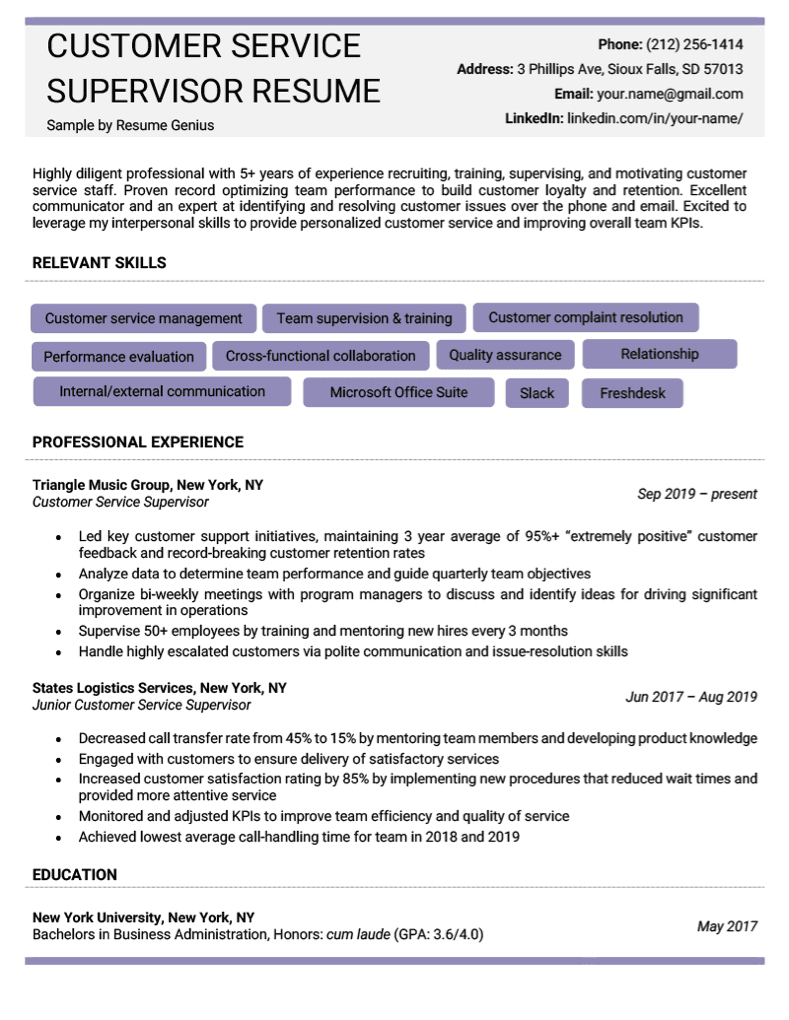
Source: ResumeGenius
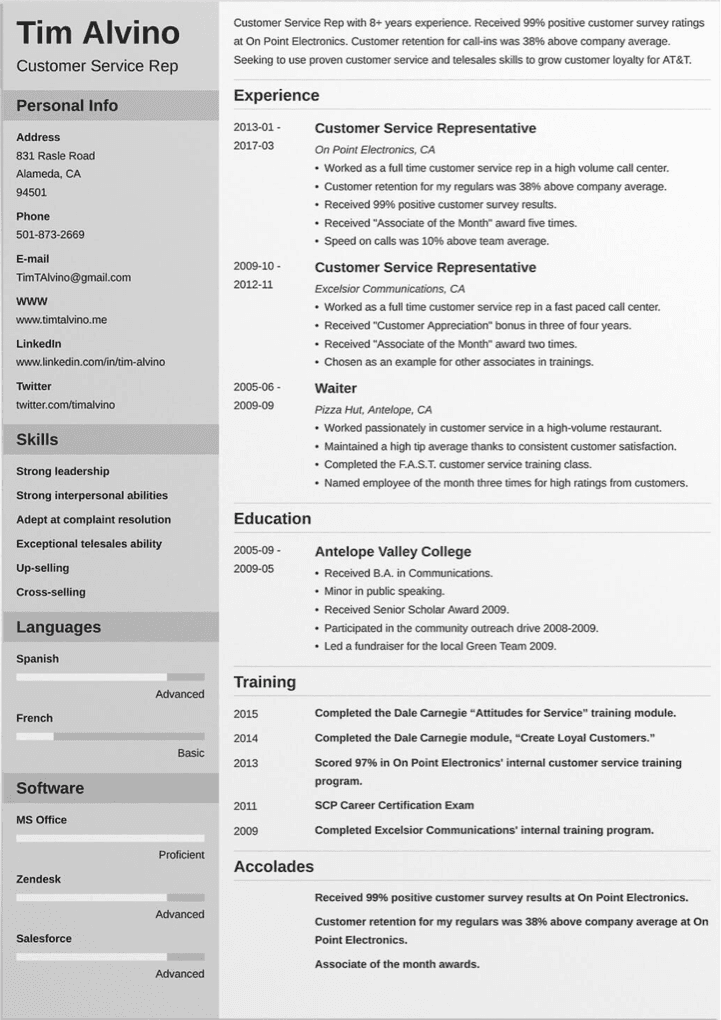
Source: Zety.com
Make Your Resume Stand Out
Complete every step of this process and you’re already ahead of the game. You’ll have a resume full of customer service experience and tangible numbers. Your resume will be crisp and easy to read. It will highlight all the key elements that hiring managers are looking for. Once you’ve done that, applications will be the easy part. Now, to nail that job interview!
5 Help Scout Alternatives: Why Growing Support Teams Switch to Groove
Groove Fixes What Teams Don't Like About Help Scout: Flat Pricing, Built-In AI, and Native SLA Management. See the Full Comparison.
How Helply's Hallucination-Proof AI Eliminates the #1 Fear of AI Customer Support
Customer Support Automation That Hits 65% AI Resolution, Guaranteed. Helply's Action-Based AI, Safe Escalations, and Optimization.