
Friday Q & A: When Should You Start Blogging, How to Hire Your First Programmer, Common Traits of Successful Blog Posts and How to Win $500

Every Friday, we’re answering your questions about business, startups, customer success and more.
Happy Friday!
In our new Groove Friday Q & A segment, we’re answering any questions that you have about, well, anything.
A huge thank you to Sébastien Tromp, Josh and Steve Klein for this week’s questions.
Check out this week’s answers below, and jump in with your own thoughts in the comments!
How Early Is TOO Early to Start Blogging?
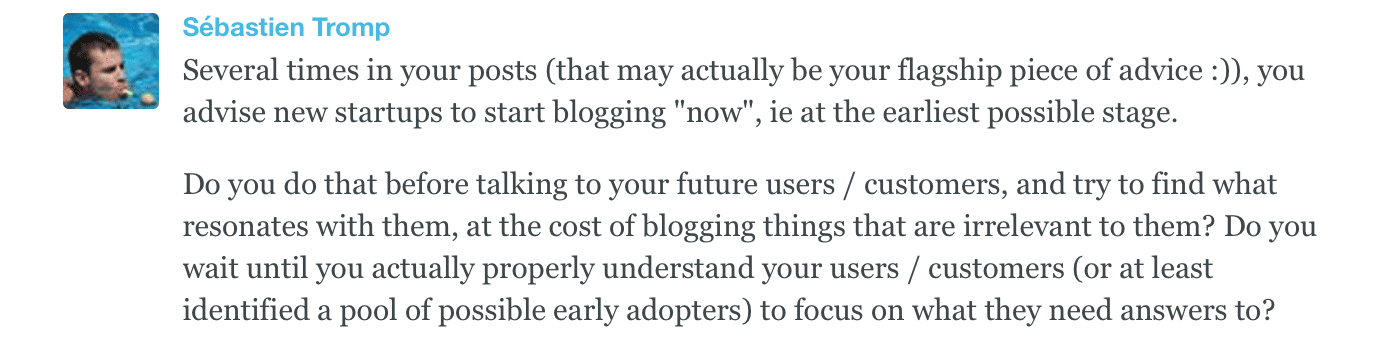
I suppose I should clarify a piece of advice I’ve been giving for some time now.
When I suggest that every single business start blogging now, I don’t necessarily mean that you need to publish something today.
What I mean to say is that every business should begin the process of developing and executing on a content marketing strategy that will bring in new customers.
If we simplify that strategy, the behavior loop would look like this:
- Figure out what your customers want to read about or solve.
- Write and publish content that fits your findings.
- Drive as much traffic as possible and convert readers into subscribers/customers.
- Repeat.
We’ve written about each step of this loop on the blog (some links here, though we have a much more comprehensive start-to-finish guide coming soon), but I wouldn’t recommend starting at Step 2.
At the same time, however, Step 1 needn’t be a drawn-out process. It can be as simple as emailing/calling 10-15 people and asking them: “what’s the biggest problem that I can solve for you?”. This simple exercise will arm you with incredibly valuable insights that can lead to your first batch of successful blog posts.
How Do You Hire Your First Programmer?

I had been a product guy for my entire career, working side-by-side with developers, so I had a bit of helpful experience when it came to actually hiring one, though we’ve certainly had our stumbles along the way.
If you’re looking for a developer to help you get your idea off of the ground, there are three things I’d recommend:
- Get comfortable—and good at—selling. You’re not just selling to customers; convincing a technical co-founder to invest in chasing your dream (and making it their dream, too) is one of the hardest sales you’ll ever have to make. A couple of my favorite books that helped me do just that are Neil Rackham’s SPIN Selling and Yes! by Noah Goldstein, Steve J. Martin and Robert Cialdini.
- Consider hiring a developer on a project basis. It’ll save you money and equity in the short-term, and you’ll be able to validate your product as you iterate, little by little. Once you have that validation, it’s a lot more likely that that same developer (or another one) will want to join the team.
- If you can swing it, consider hiring an agency to build your prototype. There are pros and cons to this, but it’ll certainly help you get something built. Just make sure to start customer development a lot sooner than we did.
In terms of feeling out whether the developer will be a good developer, this will take some trial and error, but I would absolutely ask for examples of past projects and references, and then contact each of their references and ask them the questions that are bugging you. Ideally they’ll have references that are non-technical, too, so you can get a good sense of what they’re like to work with from a perspective that’s similar to your own.
What Do Successful Blog PostsHave in Common?
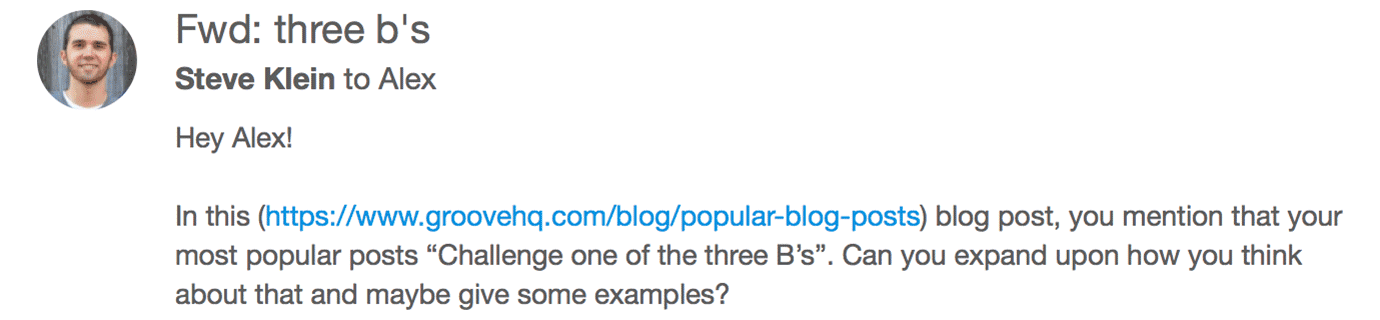
We’ve spent a ton of time trying to figure out what makes the best content…well, the best.
The “three b’s” idea was from a book I read, but I don’t remember which one, unfortunately.
As soon as I read it, a light bulb went off. I went back through all of our posts, and sure enough, the rule proved itself out across the board: the best posts provoke readers by challenging one or more of their “3 B’s”: beliefs, belongings and behavior. People are compelled to respond, to share and to be moved by that provocation.
Some examples include challenging the belief that everyone should be on Facebook or that raising money is always good, or that perhaps a physical office isn’t a necessary “belonging” for a business. Or that offering discounts might not be the best behavior.
Importantly, simply challenging one of the 3 B’s isn’t enough to make your content successful; it’s simply the cost of admission if you want people to pay attention at all.
I wish I had a repeatable formula for home runs, because then every single one of our posts would knock it out of the park, but “challenging a B” is 100% a shared trait among every single home run we’ve had.
5 Approaches To Total Quality Management
If you’re operating a small business, you’re always thinking about how to make your product or service as good as it can be. And you’re putting the best of those ideas into action. But are those changes having a tangible impact on customer satisfaction? Are there other areas where your resources would be better spent? […]
Becoming an Entrepreneur: How I Started My Very First Business with Just $300
My story of becoming an entrepreneur—and how I nearly lost everything on the very first day. “BOOM.” The vehicle shook, and I startled. “What the hell was that?,” I thought. And then, as my little car slowed to a crawl, and then to a stop, my excitement turned to a sigh of irritation as I […]