
Friday Q & A: How to Turn the Ideas You Read About Into Action, How to Market Content Marketing, and Importance of Having a System for Content Marketing

Every Friday, we’re answering your questions about business, startups, customer success and more.
Happy Friday!
In our new Groove Friday Q & A segment, we’re answering any questions that you have about, well, anything.
A huge thank you to Graham Clarke, LORD B and Rachel Krantz for this week’s questions.
Check out this week’s answers below, and jump in with your own thoughts in the comments!
How Do You Turn the Ideas You Read About Into Action?

This is an important question.
I talk a lot about the value we’ve gotten from books and blogs in helping us grow Groove. If a book or post contains even a single takeaway that we can apply to our business, then the time spent reading it is worthwhile.
Of course, there’s a lot of stuff out there to read (check out last week’s Q&A to see how I manage reading time).
And if we acted on everything we read, as soon as we read it, we’d quickly fall into a cycle of unfocused tactical experimentation that would be a huge distraction from sticking to our goals each week.
What we do is log ideas that we like in Trello. We keep a board for ideas that we come across that we may want to implement one day, but unless it pertains to a particular goal that we’re working on that quarter, we leave it alone until we need it.
This way, we have a repository of great ideas, are never at a loss for tactics to try when we consider how we want to accomplish our goals, but don’t get lost in the tactical hell of trying everything we read about.
How Do You Market Content Marketing?

There are a lot of different ways to get your content in front of people, but the simplest ways are so ridiculously effective that it’d be silly not to start with them:
- Influencer Marketing (check out our guide here, summarized in the sub-bullets below)
- Identify the people who influence your audience online
- Build relationships with them by adding value to their lives
- Get them invested in the success of your content
- Ask them for help spreading the word
- Repeat
- Write content worth sharing
- Guest blogging
That’s really all you need to do.
It’s simple, but it’s not easy. It takes work. But for us at least, the work has paid off in spades.
Is It Important to Have a System forContent Marketing?
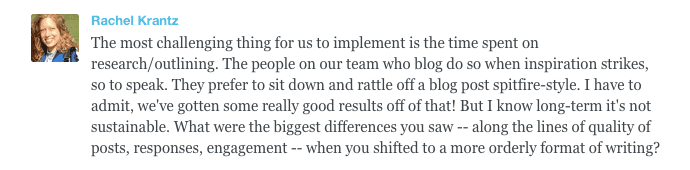
The truth is, different people work best in different conditions.
I have a good friend, a CEO of a popular SaaS startup, who doesn’t even keep a calendar or to-do list. He pretty much keeps everything in his head, and does a lot of things “as inspiration strikes.” His company is growing fast.
That’s the thing about “best practices.” They’re best for someone else.
Maybe they’re the best for you. But maybe they’re not.
You very well might find that posting when inspiration strikes is a sustainable strategy. And if it’s working well for you, that’s fantastic.
With that said, we did see some big benefits when we got more systematic in our approach:
- Our relationship with our audience got stronger, as they began to expect to hear from us on the same day every single week.
- For the same reason, we were accountable to our audience, and we knew that we couldn’t miss a week! It kept us productive.
- Thinking ahead about future content helped us be more deliberate about strategy; we analyzed what worked in previous posts and were able to plot out the “success points” for future posts in the outlining stage.
- We have a lot of moving pieces in our blog posts, between writing, editing, design and development, involving different members of the team. Having a system respects the time of everyone involved. The time that inspiration strikes the person writing might be very inconvenient for the person designing 🙂
5 Approaches To Total Quality Management
If you’re operating a small business, you’re always thinking about how to make your product or service as good as it can be. And you’re putting the best of those ideas into action. But are those changes having a tangible impact on customer satisfaction? Are there other areas where your resources would be better spent? […]
Becoming an Entrepreneur: How I Started My Very First Business with Just $300
My story of becoming an entrepreneur—and how I nearly lost everything on the very first day. “BOOM.” The vehicle shook, and I startled. “What the hell was that?,” I thought. And then, as my little car slowed to a crawl, and then to a stop, my excitement turned to a sigh of irritation as I […]