
Friday Q & A: How to Know When to Kill a Strategy, Measuring Remote Employee Performance, and Gaining Trust With Customers Who Speak a Different Language

Every Friday, we’re answering your questions about business, startups, customer success and more.
Happy Friday!
In our new Groove Friday Q & A segment, we’re answering any questions that you have about, well, anything.
A huge thank you to Benjamin Beck, Cleyton Messias and Marius for this week’s questions.
Check out this week’s answers below, and jump in with your own thoughts in the comments!
How do you decide if a strategy should be continued or stopped?

This question gets at the heart of one of the biggest challenges of being a small company.
We don’t have the volume of traffic and data that a business like Amazon or Netflix might have. Not every decision can be data-driven, because it can take a really long time to get statistically significant results for small tests.
Things like deciding whether it’s a good idea to do a giveaway, or to delete our company Facebook account, often are as much—or even more—about gut feeling as they are about metrics-driven decision making.
That can be frustrating to hear, especially in an ecosystem where it sounds like everyone is telling you that “data should drive everything.” The reality is that for 99% of businesses, that’s simply not practical. Intuition is hugely important, and plays a massive role in running a business, regardless of how unscientific it may seem.
Trying to justify everything you do with numbers will drive you crazy. Save that for tests that you know you can get great answers to based on data.
For everything else, practice the lost art of trusting your gut. And then learn from the results.
So, to answer your question: for many things (especially smaller initiatives like the giveaways), we don’t know whether it’s going to have a net positive or negative ROI in the long-term, but we make decisions based on how we feel.
Sometimes we’re right. Sometimes we’re wrong. But hopefully, every time we get better at making decisions.
How do you measure remoteemployees’ performance?

It’s been said many times, but whether deliberately or not, one of the biggest problems with the traditional office model is that for many companies, it has turned “hours worked” into a performance metric.
We don’t work on production lines where we need specific stations staffed at specific times, nor do we simply need warm bodies to be “present.” Showing up isn’t the same as getting things done.
In a perfect world, co-located businesses would realize the same thing, and the best approach for measuring remote employees’ performance would be no different than measure the performance of someone who works from the company’s office.
To me, that means measuring employees based on:
- Output: Are they productive in whatever hours they choose to work? Is their work product good? Does their work contribute to the business?
- Drive: Do they set and strive to achieve aggressive goals? Do they try to be better this week than they were last week?
- Teamwork: Are they a positive influence on the team? Do they make the people around them better? Do people like working with them?
To actually measure these things, take a combination of:
- Your own gut instinct (see my answer to question #1).
- Peer reviews from the team.
- Metrics that are specific to their role; each role is different, so you need to find metrics that can measure the effectiveness of their output (for example, a customer support agent might be measured in customer satisfaction).
Hope that helps!
If English isn’t your first language,how do you gain the trust of potential customers on phone calls?
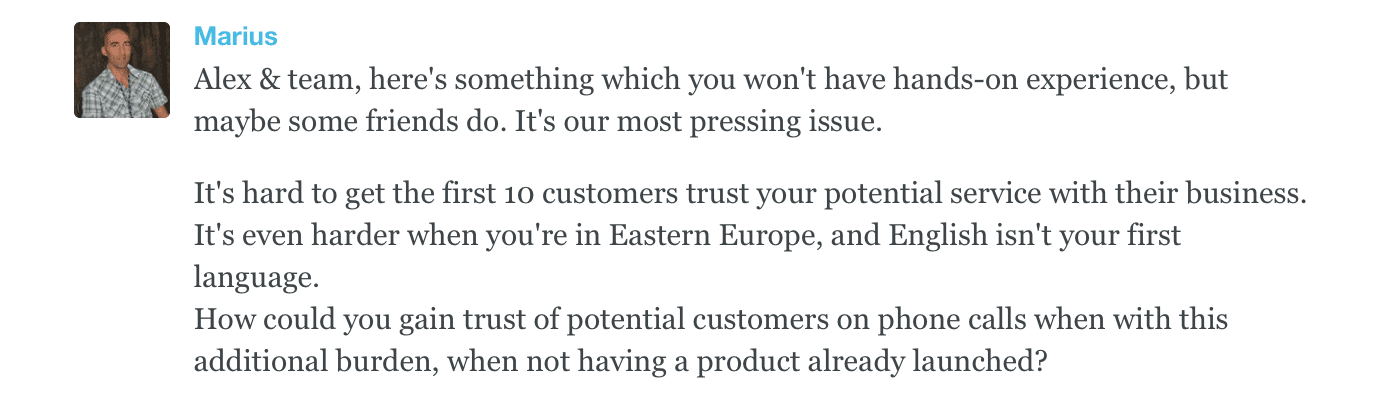
I can think of at least two software products I’ve purchased in the last year built by founders who don’t have English as their first language.
You certainly have a challenge on your hands, but I’d approach it like any other challenge: figure out how to creatively work around it.
I’m not entirely sure what your product is and the best advice will depend on your specific target customer, but three things immediately come to mind:
- You mention gaining trust. Trust doesn’t have to be gained over the phone. You could try building valuable content for your prospects that solves problems for them, and then have it translated by professionals (which can typically be done pretty cheaply; Len gave some tips on that here).
- Another option would be to bring on a team member part-time to help with pitches to English-speaking customers. If you can’t spend the money on it yet, perhaps there are some ways you can work something out for a different form of payment (equity, bartering, etc…).
- Make phone calls regardless of the language barrier. An accent or less-than-great English doesn’t make you untrustworthy. I’ve gotten very untrustworthy vibes from many people with perfect English, and have been excited to business with many people who have accents, or even people with poor grammar for whom English is their native tongue. Just keep pitching. You’ll hear a lot of “no’s”, but so does every entrepreneur. Don’t assume it’s because of your English. Just keep going until you start hearing “yes.”
I’d favor option 3, but there are a few different ways that I think you can win here.
5 Approaches To Total Quality Management
If you’re operating a small business, you’re always thinking about how to make your product or service as good as it can be. And you’re putting the best of those ideas into action. But are those changes having a tangible impact on customer satisfaction? Are there other areas where your resources would be better spent? […]
Becoming an Entrepreneur: How I Started My Very First Business with Just $300
My story of becoming an entrepreneur—and how I nearly lost everything on the very first day. “BOOM.” The vehicle shook, and I startled. “What the hell was that?,” I thought. And then, as my little car slowed to a crawl, and then to a stop, my excitement turned to a sigh of irritation as I […]