
How To Respond To Negative Customer Reviews (4 Tips for Positive Results)

Sometimes it feels like there’s absolutely nothing you can do to make a customer happy. That usually isn’t true, however, provided that you approach your response carefully.
Any review your business receives can impact growth. This is especially true for a small business, where every bit of visibility matters. Customer feedback shouldn’t be left in a dark corner, unattended to, like a problem you hope will go away on its own.
To defang the beast, we’re sharing some lessons we’ve learned across thousands of customer reviews. We’ll offer four simple tips to help you effectively respond to angry customers (or coach your support team on how to do so)!
Why Resolution Matters: The Effect of Customer Reviews on CX
Reviews are incredibly visible. Businesses with neglected reviews on TrustPilot, Facebook, Google, and other social media channels are more likely to be ignored by consumers.
If those reviews are negative, they’re even more likely to scare away potential customers. Consumers rely heavily on reviews, and they won’t give you the benefit of the doubt. Trust in businesses is declining rapidly, while at the same time many business leaders are over-confident in this area.
Almost all business executives agree on the importance of trust for accelerating their bottom lines — yet many do not account for the work required to build that trust. It won’t come naturally, and simply providing a quality product/service isn’t enough.
Smart conflict resolution is essential for creating a strong and persistent brand reputation. And that starts with customer service. Every unhappy customer still provides an opportunity to turn things around not just for them, but for your target market as a whole.
4 Tips for Responding To Negative Customer Reviews Effectively
Naturally, it falls on your customer service agents to address questions and concerns before they escalate. A negative review may relate to oversights or failures in the user experience (UX) or customer experience (CX). It may even be the result of an unpleasant interaction with one of your representatives.
Whether a negative review stems from a product issue, miscommunication, or general dissatisfaction, it requires addressing. It’s never too late to rebuild trust. You still have a chance to improve customer loyalty and satisfaction based entirely on your response. Here’s how!
Tip #1: Set Up a Clear Workflow for Managing Reviews
Responding to negative customer reviews effectively starts well before the actual reply phase. First, you need to set your support team up with the right tools and workflows. They need:
- A way to easily find reviews and gather them in one place, so they aren’t missed and are responded to promptly
- Clear organization that indicates what negative reviews need a response and who is responsible for them
- Tools and automation options to speed up and streamline the process, allowing them to tackle as many reviews as possible
This is all challenging to manage if you’re using a traditional email client for customer support. It’s even harder when you consider that reviews come in from many platforms.
That’s where Groove comes to the rescue. Groove is our customer support help desk, and it both helps you prevent negative reviews when possible, and get on top of the ones that remain before they escalate.
With Groove, you can:
- Manage all customer communications, reviews and otherwise, in the same dashboard
- Organize and prioritize reviews using folders and tags, so negative ones are attended to promptly
- Automate organization and assignment to further speed up the process
- Create canned replies that serve as a basis for your responses (to be customized for each situation, of course)
- Minimize the negative reviews you have to respond to by providing high-quality customer support, thanks to customer profiles, knowledge base creation, metric reporting, etc.
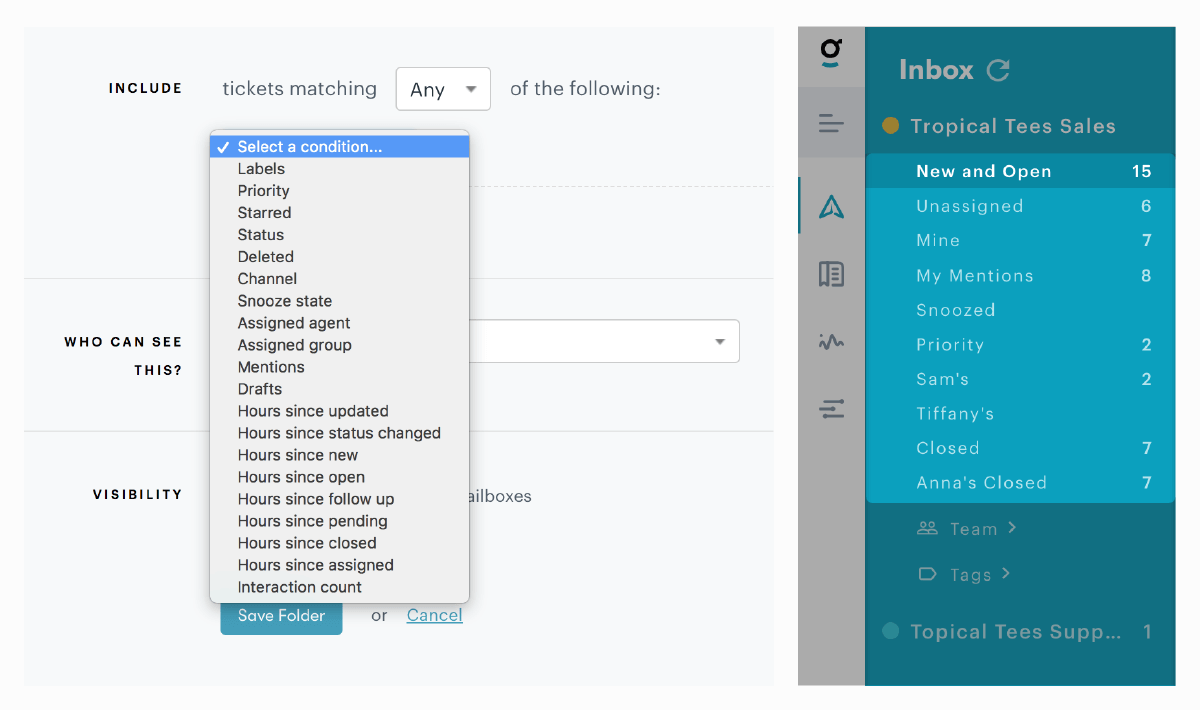
If you’ve never used a help desk before, but you’ve used Gmail or Outlook, Groove should feel immediately familiar. You can set it up in minutes, and then sit down with your support team to work out a clear workflow for gathering and responding to negative reviews.
We’d suggest starting by setting up smart folders and rules. Complaints can be easily labeled by type or degree of urgency.
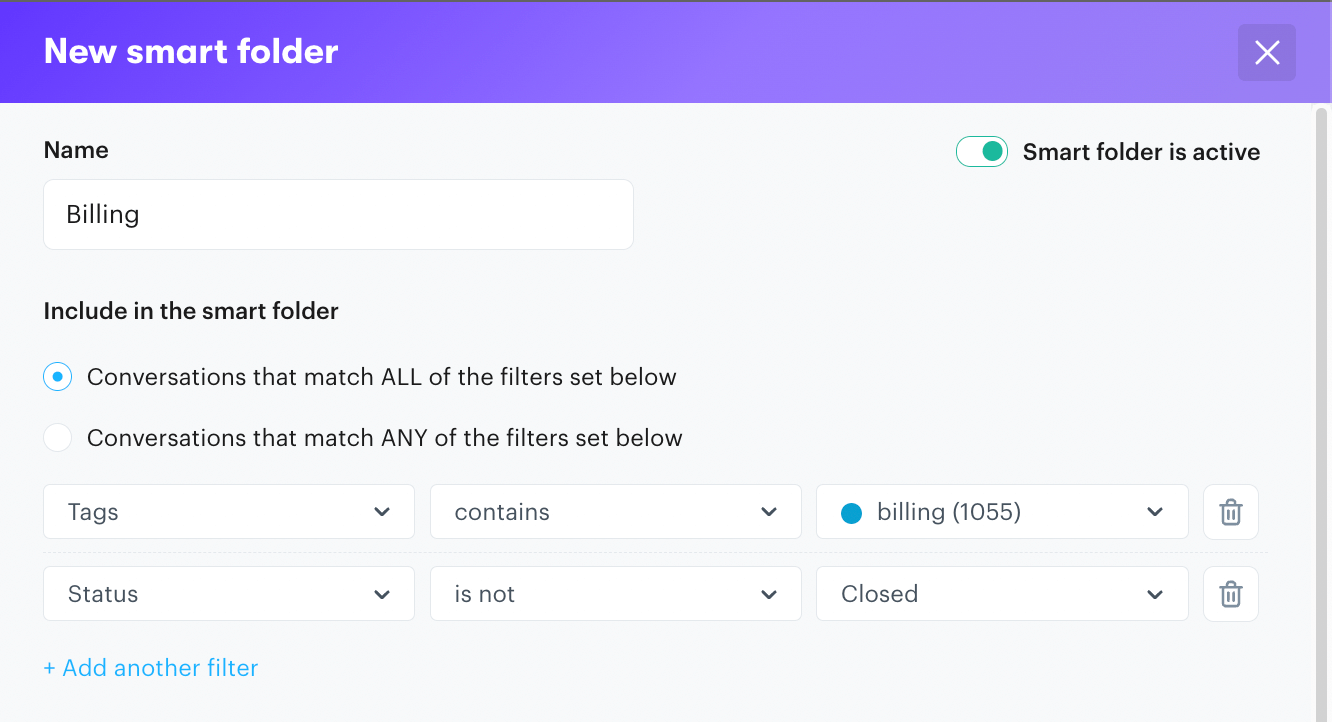
This allows you to:
- Assign a degree of urgency to each ticket, based on how serious the complaint is.
- Sort which tickets should be responded to first, based upon urgency.
- Resolve each ticket yourself, or pass it along to the appropriate team member.
- Monitor the responses from the customer, to provide further help if needed.
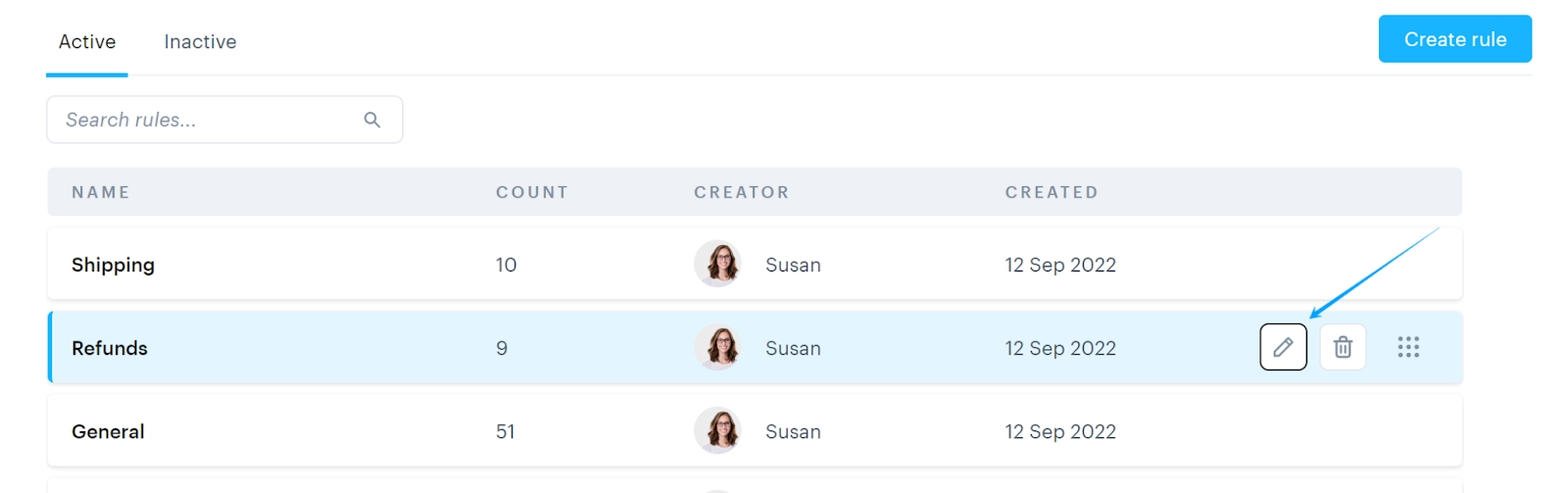
Similarly, rules can automate actions based on conditions. Anything that eliminates repetitive tasks and speeds up workflows is worth considering for your complaint resolution process.
Tip #2: Treat the Customer With Respect and Empathy
The customer should always be treated with respect. Buyers can easily identify when a business cares about their input. Few large businesses publicly respond to negative reviews, and that’s where you have a key advantage over Goliath.
At the same time, there’s a reason for that lack of response. Concerns or complaints that are handled poorly can spread through social media like wildfire — reflecting poorly on your brand as a whole.
So it’s vital to avoid using a dismissive, confrontational, or argumentative tone. It doesn’t matter if the customer is being rude or aggressive. Here’s an example of what not to do:
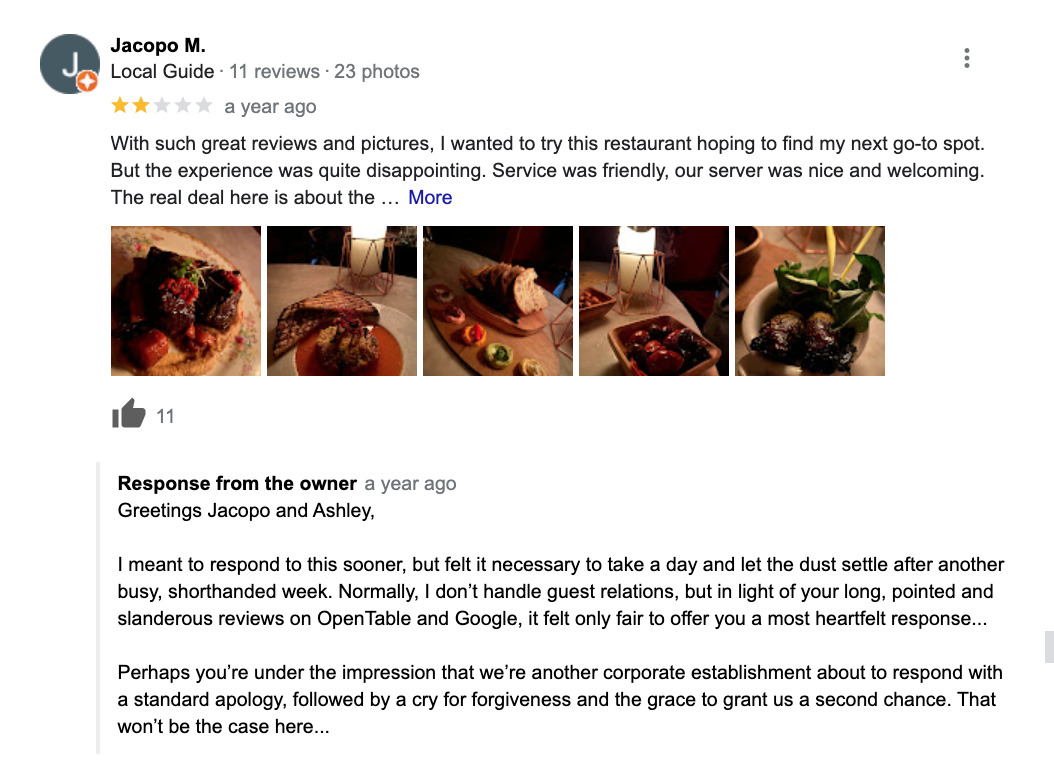
Humility is an undervalued trait, and customers are only human. The ability of your service team to acknowledge criticism and apologize—genuinely, authentically—shows care and commitment to improvement.
Empathy allows us to understand what a customer might be going through, even if we aren’t in their shoes. Responding to reviews in a respectful way requires deep empathy. Training your team on empathetic communication helps them keep their cool, understand and acknowledge the customer’s point of view, and then move things in a positive direction.
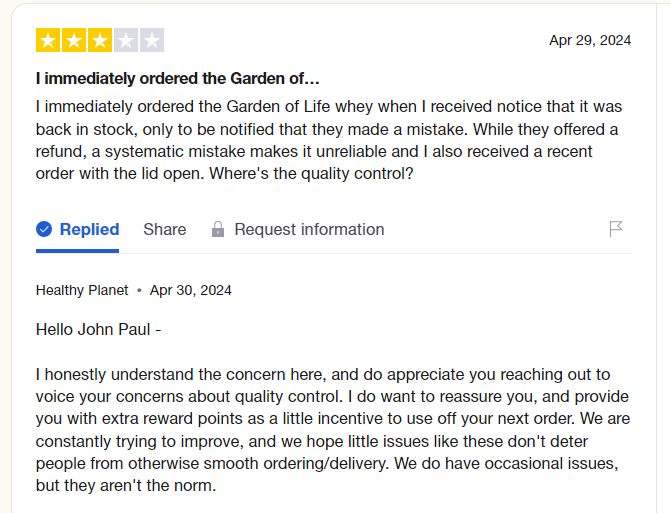
Respect also means responding quickly to negative reviews. A fast reply shows that you care about the customer’s experience, and you’re not taking it lightly. Even if a highly-personalized message isn’t possible right away, you can have a fine-tuned canned response ready to let the customer know their complaint is acknowledged (and will be addressed soon).
Tip #3: Always Provide a Solution or Compensation
When deciding how to respond to negative customer reviews, a solution-oriented mindset is key. Apologies are nice, but they don’t solve problems.
Cultivating a proactive approach to resolving complaints means expressing commitment and opening a dialogue. In turn, this signals accountability and will resonate with other potential customers who see your response.
How you do that will depend on the nature of the review:
- Take your time to consider the best possible approach. While speed is important, you don’t want to jump at a half-baked solution. You can acknowledge the complaint immediately, and then follow up when you’ve settled on the best resolution.
- Delegate what can’t be solved on your own. If you’re not the right person for the job, assign the inquiry to a teammate or manager. If you have Groove, you can use its collaboration features to cooperate on fixing a difficult situation.
- Provide a concrete solution. Assure the customer that you’ll make things right. Then, if possible, provide a tangible solution to their problem. If a product was broken or damaged in transit, this might mean replacing and reshipping the product free of charge.
- If necessary, offer an alternative resolution. If you can’t solve the problem directly, do everything you can to offer something concrete anyway. Suggest an alternative/workaround, or offer a refund/discount. Give them more than just an apology, and they’ll see that you’re serious about keeping them happy.
Your goal is to make the customer feel heard. Even if you can’t go back in time to change whatever they’re unhappy with, you can listen to their concerns and help them as much as possible now. You can also reassure them that their complaint is taken seriously, and outline the steps your business is taking to avoid similar issues in the future.
Tip #4: Encourage Post-Complaint Communication
Dealing with complaints swiftly is vital for improving customer satisfaction metrics. But it doesn’t stop once the complaint is resolved. You can learn a lot from negative reviews, and use them to build better relationships with your customers — improving retention.
Here are a few ways to engage with customers after a conflict:
- Proactively reach out to the customer to encourage communication. Let them know they can contact you (and how to do so) if they have any other concerns.
- Ask them if the problem was dealt with to their satisfaction. This shows that you value their business more than their money. And it gives you a chance to try again if they’re still unhappy.
- Offer upset customers a discount on their next purchase. It provides them with incentive to return, and allows you to make things right for them on the next order.
- Send a customer satisfaction survey via Groove’s automatic survey templates. This lets you know if you resolved the issue to their satisfaction. Plus, it gives the customer another chance to express their feelings and be heard.
It’s also important to keep track of the negative reviews you receive. Some may turn out to be one-off issues, or even unreasonable complaints.
But over time you should be able to spot trends that tell you what parts of the CX require attention. You can then share the positive changes you’ve made via your blog or social media, letting current and potential customers see how seriously you take their feedback.
Prevention Is the Best Resolution for Negative Reviews
The importance of quality customer service cannot be overstated. Knowing how to respond to negative customer reviews is great. Preventing them from happening in the first place is even better.
Groove can reduce negative feedback through its streamlined inbox, CSAT tracking, automated support options, and many third-party integrations. Reviews, complaints, and inquiries of all kinds are less overwhelming and easier to manage through multiple channels with a comprehensive help desk solution.
In other words, we want to minimize your workload so your support team can maximize quality. Sign up for a free trial of Groove, and keep your customers happier than ever!
5 Help Scout Alternatives: Why Growing Support Teams Switch to Groove
Groove Fixes What Teams Don't Like About Help Scout: Flat Pricing, Built-In AI, and Native SLA Management. See the Full Comparison.
How Helply's Hallucination-Proof AI Eliminates the #1 Fear of AI Customer Support
Customer Support Automation That Hits 65% AI Resolution, Guaranteed. Helply's Action-Based AI, Safe Escalations, and Optimization.